


Hello, it’s Katie. If you’re feeling a little overwhelmed lately, please know that you are not alone. We’ve all been there, those moments where everything feels like too much, and the world seems to be spinning too fast. It’s in these times that the kindest thing we can do for ourselves is to simply pause and breathe.
The idea of ‘meditation’ might sound complicated or intimidating, but I promise you, it doesn’t have to be. Think of it as a gentle space you create just for you, a few quiet moments to soften and reconnect with yourself. This isn’t about emptying your mind or achieving some perfect state of bliss. It’s simply about allowing yourself to be, just as you are, without judgement.
Today, I’d like to softly guide you through some simple meditation techniques for beginners. We will gently explore several easy-to-learn practices, from focusing on your breath to sending kind wishes to yourself and others. Let’s explore them together, with kindness and curiosity, and discover what feels most supportive for you right now on your journey toward stillness and calm.
1. Mindfulness Meditation
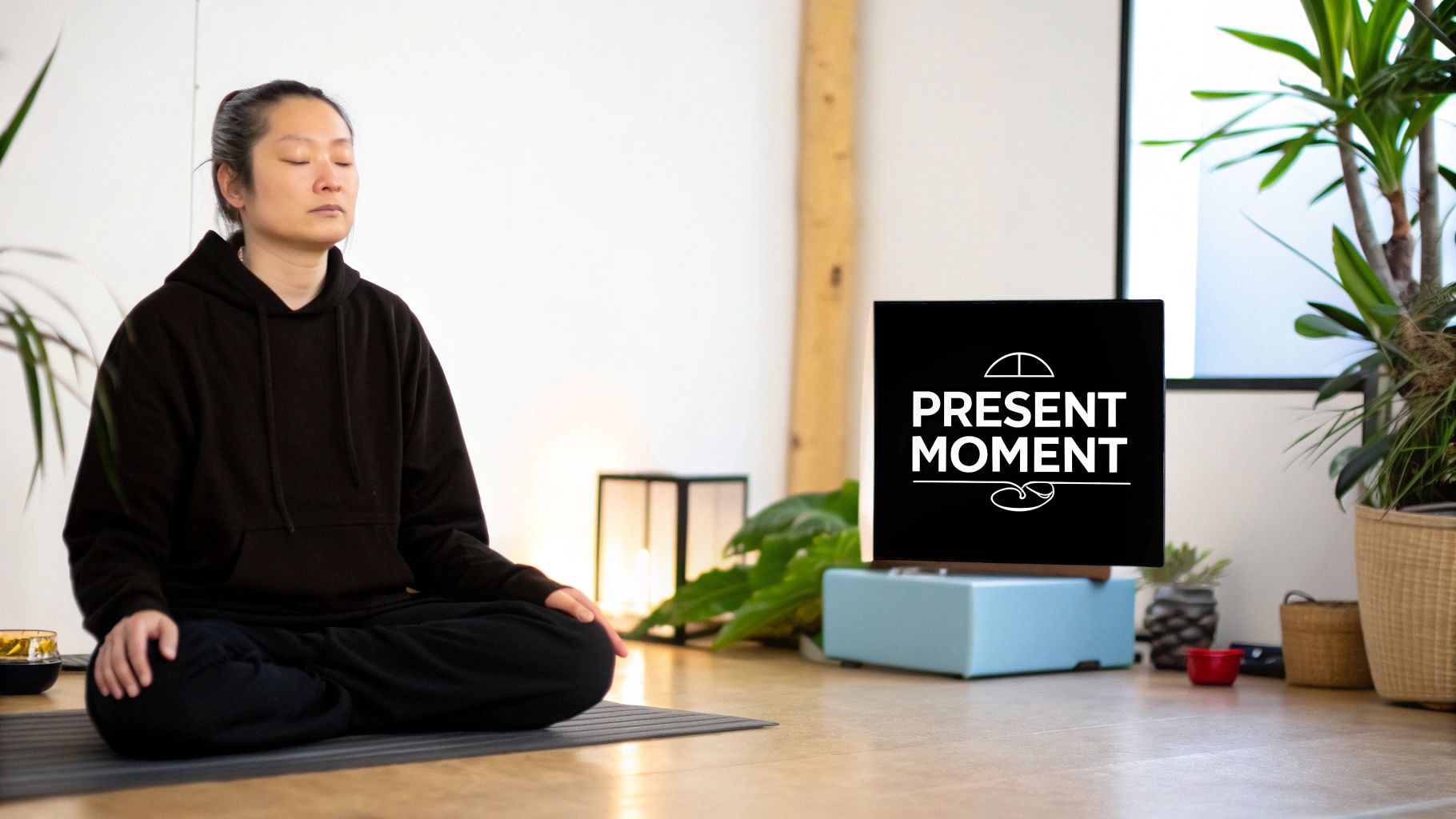
If you’re feeling pulled in a million directions, with your mind constantly racing ahead to the next task, I want to offer you a gentle anchor. This is what mindfulness meditation provides. It’s a quiet practice of bringing your awareness into the present moment, observing your thoughts, feelings, and bodily sensations without judging them as ‘good’ or ‘bad’. Think of it as sitting peacefully on a riverbank, simply watching your thoughts float by like leaves on the water.
This approach, rooted in ancient Buddhist traditions, has been lovingly adapted for our modern lives. It’s not about emptying your mind, which can feel like an impossible task. Instead, it’s about allowing everything to be as it is, just for a few moments, and gently returning your focus to your breath or your body whenever you notice your mind has wandered.
Why It’s a Perfect Starting Point
Mindfulness is perhaps one of the most accessible meditation techniques for beginners because it meets you exactly where you are. Its power lies in its simplicity and its profound ability to reduce stress by untangling us from our habitual thought patterns. Esteemed teachers like Jon Kabat-Zinn, who created the Mindfulness-Based Stress Reduction (MBSR) programme, have brought this gentle practice into hospitals and wellness centres worldwide, demonstrating its deep healing potential. Even major organisations like Google have woven it into their culture to support employee well-being.
How to Begin Your Practice
I invite you to try this simple, supportive practice. There’s no pressure to get it ‘right’; the only goal is to be present with yourself.
- Start Small and Softly: Begin with just five minutes a day. Find a quiet, comfortable space where you won’t be disturbed. You can sit on a cushion or a chair, whatever feels most supportive for your body.
- Focus on Your Breath: Gently close your eyes and bring your attention to the natural rhythm of your breath. Notice the sensation of the air entering your nostrils and filling your lungs, and the feeling of release as you exhale.
- Acknowledge Wandering Thoughts: Your mind will wander. That’s completely natural. When it does, gently acknowledge the thought without criticism, and then lovingly guide your attention back to your breath. Each time you do this, you are strengthening your muscle of awareness.
“The best way to capture moments is to pay attention. This is how we cultivate mindfulness. Mindfulness means being awake. It means knowing what you are doing.” – Jon Kabat-Zinn
This practice offers a precious gift: the space to pause, breathe, and reconnect with yourself, bringing a sense of calm and clarity that can ripple out into every corner of your life.
2. Focused Attention Meditation (Breath Meditation)
If your mind feels scattered, like a whirlwind of thoughts and to-do lists, this practice offers a single, calm point to rest upon. Focused attention meditation is the gentle art of concentrating on one specific thing, most often the breath, to steady and anchor your awareness. It’s like holding a candle in a dark, breezy room; your job isn’t to stop the breeze, but to keep your gaze softly on the flame.
This technique is one of the most foundational practices across many traditions, from Anapanasati in Buddhism to Pranayama in yoga. The goal isn’t to force your mind into silence but to create a peaceful home base for your attention. Whenever you notice your thoughts have drifted, you simply guide them back with kindness and patience, strengthening your focus each time you return.

Why It’s a Perfect Starting Point
Focused attention is wonderfully straightforward, making it one of the most supportive meditation techniques for beginners. By giving your mind a single, simple task-to observe the breath-it reduces the feeling of being overwhelmed. This practice is at the core of most meditation apps and introductory courses because it builds the fundamental “muscle” of concentration. Teachers and neuroscientists alike celebrate its ability to improve focus, reduce distraction, and cultivate a deep sense of inner calm that can help you calm your mind both on and off the cushion.
How to Begin Your Practice
I invite you to explore this simple practice with a sense of gentle curiosity. Remember, there’s no need for perfection, only a willingness to be present with yourself.
- Find Your Anchor: Settle into a comfortable position and bring your awareness to your breath. Choose one spot to focus on: the feeling of air at your nostrils, the rise and fall of your chest, or the gentle expansion of your belly.
- Count with Kindness: To help your mind settle, you might try silently counting your breaths. Inhale one, exhale two, all the way up to ten, and then begin again. This gives your mind a simple rhythm to follow.
- Return, Don’t Reprimand: When your mind wanders off (and it will!), see it as an opportunity. Softly notice where it went, and then gently, without any judgment, guide it back to the sensation of your breathing.
“Your breath is your anchor. In the midst of the storm of your thoughts, it is the one thing that is always with you, always in the present moment.” – Thich Nhat Hanh
This loving practice of returning your focus, again and again, offers a profound gift: the ability to find stillness and stability, no matter what is swirling around you.
3. Body Scan Meditation
So often, we live in our minds, disconnected from the very bodies that carry us through life. I want to gently guide you back home to yourself with a practice called body scan meditation. This is a deeply nurturing technique where you systematically bring your awareness to different parts of your body, from your toes all the way up to the crown of your head, simply noticing any sensations like warmth, tingling, or tension without any need to change them.
This practice is like slowly drawing a warm, comforting blanket of attention over your entire body. It’s a foundational element of many therapeutic approaches, including Mindfulness-Based Stress Reduction (MBSR), because of its incredible power to soothe the nervous system and reconnect the mind and body. It’s not about judging what you feel, but simply about being present with it, allowing your body to feel heard and cared for.

Why It’s a Perfect Starting Point
If you find it hard to focus on the breath alone, a body scan can offer a more tangible anchor for your attention. It’s one of the most effective meditation techniques for beginners who experience physical symptoms of stress or find it difficult to relax and fall asleep. By tuning into your physical self, you create the conditions for deep rest and release. This is why practices like Yoga Nidra, a form of guided meditative relaxation, are so profoundly restorative; they use the body as a gentle gateway to stillness.
How to Begin Your Practice
I invite you to settle in and offer this gift of quiet attention to your body. There is no right or wrong way to feel, only your own unique experience.
- Settle in Comfortably: Lie down on your back if you can, perhaps on a yoga mat or your bed, with your arms resting by your sides. If sitting is better for you, that’s perfectly fine too.
- Start at Your Feet: Gently bring your awareness to the toes of your left foot. Notice any sensations without judgement. Slowly, lovingly, move your attention up your foot, to your ankle, calf, and all the way up your left leg, before repeating on the right side.
- Move Through the Body: Continue this systematic scan, moving through your torso, your arms and hands, and finally to your neck, face, and head. If your mind wanders, just softly guide it back to the part of the body you were focusing on.
“Your body is your home. The body scan offers a way to come home and, in the caring, to find a place of stillness and insight.” – Jack Kornfield
This beautiful practice teaches you to inhabit your body with a kind, gentle awareness, creating a deep sense of grounding and peace that you can carry with you long after the meditation is over.
4. Loving-Kindness Meditation (Metta)
If your inner critic often speaks the loudest, or if you feel a little disconnected from yourself and others, I’d like to introduce you to a practice that feels like a warm, heartfelt embrace. This is Loving-Kindness meditation, also known as Metta. It’s a beautiful practice of actively cultivating feelings of warmth, goodwill, and compassion, first for yourself and then extending them outwards to the world. Think of it as tending to a gentle flame of kindness within your own heart until it glows brightly enough to warm everyone around you.
This practice comes from ancient Buddhist traditions and is a powerful way to soften the heart and dissolve feelings of resentment or isolation. It’s not about forcing an emotion you don’t feel; instead, it’s a gentle invitation to plant the seeds of kindness and patiently watch them grow. It’s a profound reminder that we are all worthy of love and peace.

Why It’s a Perfect Starting Point
Loving-Kindness is one of the most nurturing meditation techniques for beginners because it directly counters our tendencies toward self-criticism and judgment. Its power is in its ability to actively generate positive emotional states, which can enhance feelings of social connection and reduce negativity. Esteemed teachers like Sharon Salzberg have brought this practice to the forefront, showing how it can heal emotional wounds and foster genuine happiness. The gentle repetition involved offers a clear focus for a wandering mind, making it wonderfully accessible.
How to Begin Your Practice
I invite you to try this supportive practice with an open and gentle heart. There is no right or wrong way to feel; the intention is what matters most.
- Start with Yourself: Begin by finding a comfortable, quiet place to sit. Gently close your eyes and silently repeat phrases of kindness toward yourself. You could try: “May I be happy. May I be healthy. May I be safe. May I live with ease.”
- Extend Your Kindness Outwards: After a few minutes, bring to mind someone you love dearly, like a friend or a pet, and offer them the same wishes. Then, gradually extend these phrases to a neutral person, and eventually, to someone you find difficult. This helps to grow your circle of compassion.
- Use Visualisation: As you repeat the phrases, you might find it helpful to picture the person you are focusing on, imagining them receiving your warm wishes and feeling happy and well. Allow any feelings that arise to be there without judgment. Just like in our gentle Reiki sessions, it’s about allowing healing energy to flow. You can discover more about unlocking your inner peace on our website.
“Metta is the ability to embrace all parts of ourselves, as well as all parts of the world. Practicing loving-kindness enables us to touch the wholeness of our being and the wholeness of the world.” – Sharon Salzberg
This practice offers the precious gift of self-compassion, helping you to build a kinder, more loving relationship with yourself and everyone you meet.
5. Walking Meditation
If you feel restless, or the idea of sitting still feels like a mountain to climb, I want to invite you to find your stillness in motion. This is the beautiful gift of walking meditation. It’s a practice that marries the gentle rhythm of your body with the quiet awareness of your mind, grounding you in the here and now with each and every step. Think of it as a conversation between your feet and the earth, a simple act of presence that soothes the soul.
This profound technique, deeply rooted in Buddhist traditions and lovingly shared by teachers like Thich Nhat Hanh, transforms a simple walk into a moving sanctuary. It’s not about getting anywhere in particular; it’s about fully arriving in each moment. You simply bring a gentle, focused attention to the physical act of walking, allowing it to anchor your awareness and quiet the noise within.
Why It’s a Perfect Starting Point
For many of us, especially when we feel anxious or full of pent-up energy, sitting meditation can be a real challenge. Walking meditation offers a wonderful, accessible alternative. It provides a physical outlet for restlessness while still cultivating deep mindfulness. This practice is central to many retreat centres and has inspired modern movements like forest bathing (Shinrin-yoku), which celebrates the healing connection between mindful movement and nature. It’s a perfect way to integrate meditation into daily life, turning a walk to the shops or a stroll in the park into a restorative practice.
How to Begin Your Practice
I encourage you to try this gentle, grounding practice. There is no right or wrong way to do it; simply allow yourself to move and be present.
- Find Your Path: Choose a short, clear path where you can walk back and forth without distraction, perhaps a hallway in your home or a quiet patch of grass outside. Ten to fifteen minutes is a lovely starting point.
- Slow Your Pace: Begin walking at a pace that is slower than your usual stride. Bring your awareness to your feet. Notice the sensation of lifting one foot, moving it through the air, and placing it gently back on the ground.
- Anchor Your Awareness: Focus on the physical sensations. Feel the contact of your sole with the floor or the earth. When your mind wanders, as it naturally will, just gently guide it back to the feeling of your feet walking. Each return is a moment of peaceful practice.
“Walk as if you are kissing the Earth with your feet.” – Thich Nhat Hanh
This beautiful practice shows us that peace isn’t something we must sit still to find; it’s a presence we can carry with us, one mindful step at a time.
6. Guided Visualisation Meditation
If your mind is a wanderer, often finding it hard to settle on just one thing like the breath, I want to offer you a more creative and imaginative path. This is the beauty of guided visualisation meditation. It’s a gentle practice where you use your mind’s eye to journey to peaceful places, create healing experiences, or envision positive outcomes, all led by a calming voice. Think of it as painting a beautiful, soothing picture inside your own mind, engaging your senses to make the experience feel rich and real.
This technique uses the power of storytelling and mental imagery to guide your awareness. Instead of trying to quieten your thoughts, you give your mind a gentle, positive story to follow. It’s a wonderfully immersive approach that allows you to step away from your current worries and into a space of deep relaxation and possibility, all within the comfort of your own imagination.
Why It’s a Perfect Starting Point
Guided visualisation is one of the most nurturing meditation techniques for beginners because it provides a clear focus for a busy mind. Its strength lies in its ability to harness your imagination for healing and calm. Esteemed guides like Belleruth Naparstek have pioneered therapeutic guided imagery in medical centres to help with pain and recovery, while figures like Deepak Chopra have popularised it for spiritual and emotional well-being. It’s even a core tool in sports psychology, helping athletes mentally rehearse success.
How to Begin Your Practice
I invite you to explore this gentle journey inwards. There is no right or wrong way to imagine; the only aim is to allow yourself to be guided.
- Find Your Sanctuary: Choose a guided meditation that speaks to you. There are thousands available on apps and online. Settle into a cosy space where you feel safe and won’t be disturbed.
- Allow the Story to Unfold: Gently close your eyes and listen to the narrator’s voice. Allow their words to create images, sounds, and feelings in your mind. You might picture a serene forest, a calm beach, or a warm, healing light.
- Engage Your Senses: Don’t worry if the images aren’t perfectly clear. Simply focus on the feeling. What can you hear in your imagined place? What can you smell? How does the warm sun feel on your skin? The more you can gently engage your senses, the more immersive the experience will be.
“Imagination is the beginning of creation. You imagine what you desire, you will what you imagine and at last you create what you will.” – George Bernard Shaw
This practice offers a precious escape, a creative way to soothe your nervous system and connect with a deep sense of peace, showing you that your own mind holds a powerful key to relaxation and healing.
7. Mantra Meditation
If your mind is often busy and restless, you may need a gentle focal point. Because of this, I want to introduce you to the soothing power of sound. Mantra meditation offers an anchor by using a repeated word or phrase. Specifically, this repetition creates a beautiful, calming rhythm. Consequently, it can quieten mental chatter and bring you into a state of deep peace.
The word ‘mantra’ comes from Sanskrit and means a ‘tool for the mind’. In fact, this practice is found in many cultures across the world. For example, it ranges from the sacred sound ‘Om’ to the contemplative use of prayer. Furthermore, the mantra gives your wandering mind a gentle, specific task. As a result, it becomes much easier to let go of distracting thoughts and settle into stillness. Ultimately, this is one of the best meditation techniques for beginners because it offers both structure and soul.
Why It’s a Perfect Starting Point
For those of us with active minds, mantra meditation can feel more engaging than silent practices. Consequently, the vibrational quality of repeating a sound has a profoundly grounding effect on the nervous system. You can choose to repeat these sounds either aloud or internally.
Furthermore, esteemed teachers like Deepak Chopra have shared this practice widely. In fact, they have shown how it can effortlessly lead the mind to a quieter state. This method is wonderfully supportive because it doesn’t demand total silence. Instead, it gives you a beautiful, rhythmic sound to focus on. As a result, the mind finds it much easier to settle and relax.
How to Begin Your Practice
I invite you to explore this resonant practice with an open heart. There’s no perfect mantra, only the one that feels right for you in this moment.
- Choose a Gentle Mantra: You can begin with a universal sound like ‘Om’ or a simple, affirming phrase like “I am calm.” The key is to select something that feels neutral or positive to you. Don’t overthink it; trust your intuition.
- Find Your Rhythm: Find a comfortable seated position and close your eyes. Begin to repeat your mantra, either silently to yourself, in a soft whisper, or gently aloud. You might like to coordinate the repetition with your breath, perhaps saying it silently on each exhale.
- Return with Kindness: Just like in other practices, your mind will wander. When you notice this has happened, simply and kindly guide your awareness back to the sound of your mantra. Each return is a moment of gentle self-care.
“Every time you are tempted to react in the same old way, ask if you want to be a prisoner of the past or a pioneer of the future.” – Deepak Chopra
This practice offers a loving way to transform your inner world, one sound at a time. To explore this technique further, you might find some gentle guidance on how to return to stillness on natural-light-surrey.com.
Meditation Techniques Comparison Matrix
| Meditation Type | Implementation Complexity | Resource Requirements | Expected Outcomes | Ideal Use Cases | Key Advantages |
|---|---|---|---|---|---|
| Mindfulness Meditation | Moderate – requires consistent practice | None | Stress reduction, emotional regulation | Daily stress, emotional awareness | Easy integration, extensive research support |
| Focused Attention Meditation | Low – simple focus on breath | None | Improved concentration, calming | Beginners, foundational skill-building | Straightforward, quick calming effect |
| Body Scan Meditation | Moderate – longer sessions | Quiet, comfortable space | Deep relaxation, body awareness | Stress, sleep preparation, chronic pain | Excellent for relaxation and tension release |
| Loving-Kindness Meditation | Moderate – emotionally demanding | None | Increased compassion, empathy | Emotional well-being, self-criticism | Builds empathy and social connection |
| Walking Meditation | Low to moderate – requires safe space | Safe walking area | Mindful movement, increased alertness | Those who struggle sitting still | Energizing, connects meditation with activity |
| Guided Visualization Meditation | Moderate – guided instructions needed | Audio/instructor guidance | Relaxation, healing, personal growth | Visual learners, therapeutic settings | Engaging, structured guidance |
| Mantra Meditation | Low – repetition of words/sounds | None | Focused attention, spiritual connection | Those seeking mental focus, spiritual practice | Clear focus point, versatile practice |
Your Next Gentle Step: Continuing Your Journey
As we close our exploration of these gentle meditation techniques, my greatest hope is that you feel invited rather than obligated. Throughout this guide, we have journeyed through several pathways to stillness. For instance, we explored the focused calm of Breath Meditation and the warmth of Loving-Kindness practices. In addition, we looked at the grounding presence of Walking Meditation. Each technique is a unique key ready to unlock a quieter space within you.
Ultimately, the most important takeaway is that there is no “right” way to meditate. Instead, there is only the way that feels right for you at this moment. Perhaps the structured awareness of the Body Scan resonated with you. Alternatively, maybe the creative journey of a Guided Visualisation felt like a comforting escape.
However, your only real task is to remain curious and gentle with yourself. Furthermore, remember that this is not another task for your to-do list. On the contrary, it is a sacred space to subtract the noise and pressure of your day.
Weaving Stillness into Your Life
So, what is your next gentle step? It doesn’t need to be grand. True transformation often begins with the smallest, most consistent acts of self-care. Here are a few soft invitations to carry with you:
- Choose Just One: Instead of feeling you must master all seven techniques, pick one that sparked your interest. Commit to trying it for just three to five minutes each day for a week. See how it feels. Notice any subtle shifts in your mood or clarity.
- Link it to a Habit: Anchor your new practice to something you already do. For example, you might practise your chosen meditation right after your morning cup of tea or just before you turn off the light at night. This makes it easier to remember and integrate.
- Listen to Your Needs: On a busy, overwhelming day, a Walking Meditation might be more supportive than trying to sit still. On a day you’re feeling disconnected or critical of yourself, a Loving-Kindness Meditation could be the perfect balm. Let your inner wisdom guide your choice.
Mastering these foundational techniques is not about achieving a perfectly silent mind. Instead, it is about learning to sit with yourself. You can learn to listen to your inner world with compassion. Furthermore, you will realize that you are the true source of your own peace.
Consequently, creating moments of intentional pause will ripple outwards. These moments bring more presence and patience to your relationships and your work. In addition, this practice supports your overall wellbeing. This journey is a beautiful, personal process of returning home to yourself.
However, you may eventually feel the need for a dedicated space to deepen this sense of calm. If so, please know we are here to support you at Natural Light Wellness Spa in Guildford. Our serene meditation garden and soothing treatments are specifically designed to help you reconnect.
Regardless of where your path leads, remember that you are allowed to rest. Because you have everything you need within you, you can begin right now. Above all, be so, so gentle with yourself.


