


Hello, lovely. It’s Katie here. Does life sometimes feel like you’re carrying a heavy backpack, one you never get to set down? If your shoulders are tight, your mind is racing, and a sense of calm feels worlds away, please know you’re not alone. So many of us are navigating the choppy waters of anxiety, searching for a quiet harbour. In this space, we’re going to gently explore some beautiful, practical ways to find that stillness.
Think of this as a warm cup of tea and a comforting chat, where I’ll share some simple yet powerful relaxation techniques for anxiety. These aren’t about ‘fixing’ anything, but rather about tenderly inviting your body and mind back into balance. We will walk through everything from focused breathing and mindfulness to gentle movement and aromatherapy, offering actionable steps you can try today. Each technique is a small, compassionate step you can take to lighten your load and rediscover your centre. For those seeking even more support, it can be helpful to explore a comprehensive guide on how to reduce anxiety for a broader look at practical strategies.
Our journey together is about empowerment, giving you a collection of tools you can turn to whenever you need them. Let’s take a soft breath together and begin.
1. Deep Breathing Exercises
When you feel your chest tighten and your thoughts start to race, it can feel like you’re carrying a heavy backpack that you can’t put down. One of the most direct and powerful relaxation techniques for anxiety is simply to breathe, but to do so with intention. Deep breathing exercises are a way to signal safety to your nervous system, gently guiding it from a state of fight-or-flight back to a place of calm.
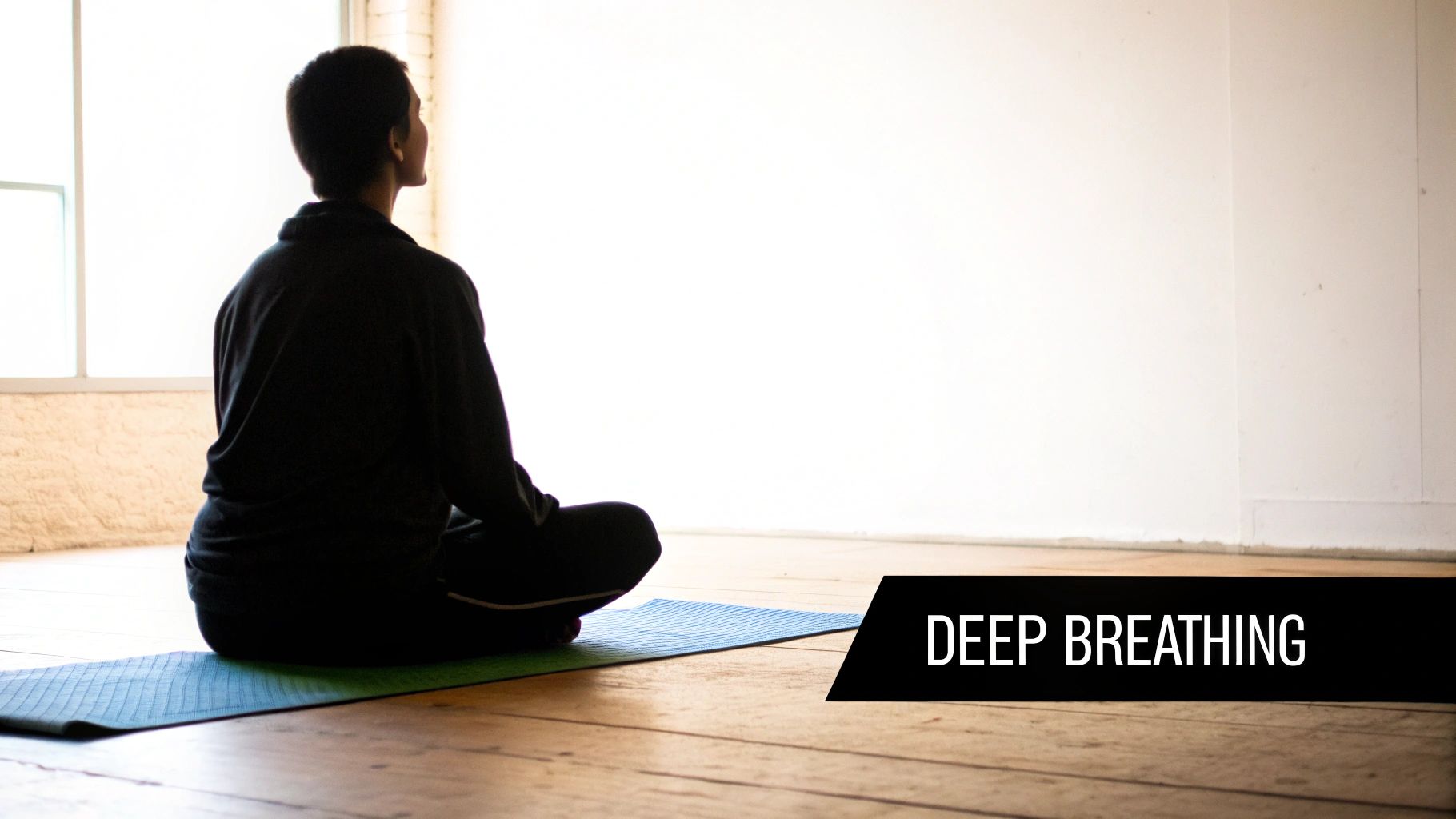
This technique involves slow, deliberate breaths that engage your diaphragm, the muscle just below your lungs. This action activates the parasympathetic nervous system, which is your body’s natural relaxation response. As you do this, your heart rate slows, your blood pressure lowers, and your mind begins to clear, offering immediate relief.
Putting it into Practice
You don’t need any special equipment, just a few moments to yourself. Here’s a simple way to start, inspired by the popular 4-7-8 method:
- Find a quiet space: Sit or lie down comfortably. Place one hand on your chest and the other on your belly.
- Inhale: Breathe in quietly through your nose for a count of four. Feel your belly rise more than your chest.
- Hold: Gently hold your breath for a count of seven.
- Exhale: Breathe out completely through your mouth for a count of eight, making a soft whooshing sound.
This rhythmic pattern helps to interrupt anxious thought loops and grounds you firmly in the present moment. Practising for just five minutes a day can build resilience against stress.
This simple yet profound practice is a cornerstone of our wellness philosophy here at Natural Light Wellness Spa. It’s a tool you can carry with you anywhere, from a stressful meeting to a sleepless night, offering a pocket of peace whenever you need it.
2. Progressive Muscle Relaxation (PMR)
When anxiety takes hold, it often creates a physical armour of tension in our bodies, clenching our jaw, shoulders, and fists without us even realising. Progressive Muscle Relaxation (PMR) is a deeply grounding technique that teaches you to release this stored-up stress. It’s like a conversation with your body, learning to distinguish the sensation of tightness from the feeling of complete release.
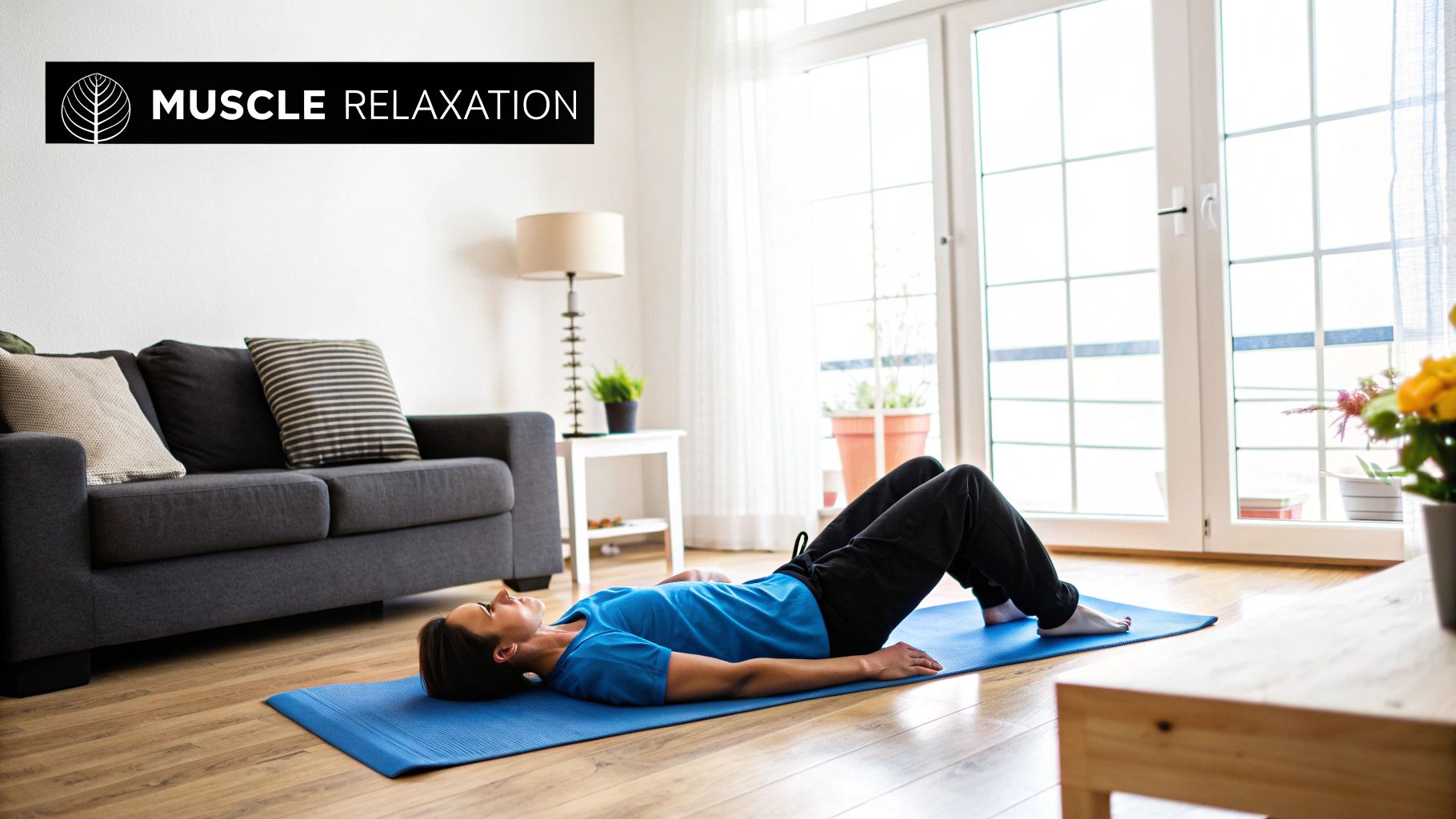
This powerful mind-body practice involves systematically tensing and then relaxing different muscle groups. By deliberately creating tension, you make the subsequent feeling of relaxation more profound and noticeable. This process helps to lower overall physical tension, reduce physiological arousal associated with anxiety, and can even help improve sleep quality, making it a cornerstone of many therapeutic approaches.
Putting it into Practice
To begin this practice, find a comfortable and quiet space where you won’t be disturbed for about 10-15 minutes.
- Get comfortable: Lie down on your back or sit in a supportive chair. Close your eyes and take a few gentle, deep breaths.
- Tense and release: Starting with your feet, curl your toes tightly for about five seconds. Notice the feeling of tension.
- Let go: Release the tension completely and focus on the feeling of relaxation in your feet for about 15-20 seconds.
- Work your way up: Continue this tense-and-release pattern, moving systematically up through your body: calves, thighs, hands, arms, shoulders, and face.
By paying close attention to these physical sensations, you anchor your mind in the present moment, interrupting the cycle of anxious thoughts and promoting a state of deep calm.
PMR is one of the relaxation techniques for anxiety that we often recommend because it empowers you to actively soothe your own nervous system. It’s a wonderful, tangible skill to cultivate, offering a path back to physical and mental ease when you need it most.
3. Mindfulness Meditation
When your mind is a whirlwind of ‘what ifs’ and worries, it can feel impossible to find a quiet corner to rest. Mindfulness meditation is a gentle invitation to step out of that storm. This ancient practice teaches us to pay attention to the present moment, observing our thoughts and feelings from a distance without getting swept away by them. It’s about being a kind observer of your own mind, which can be a profoundly effective relaxation technique for anxiety.
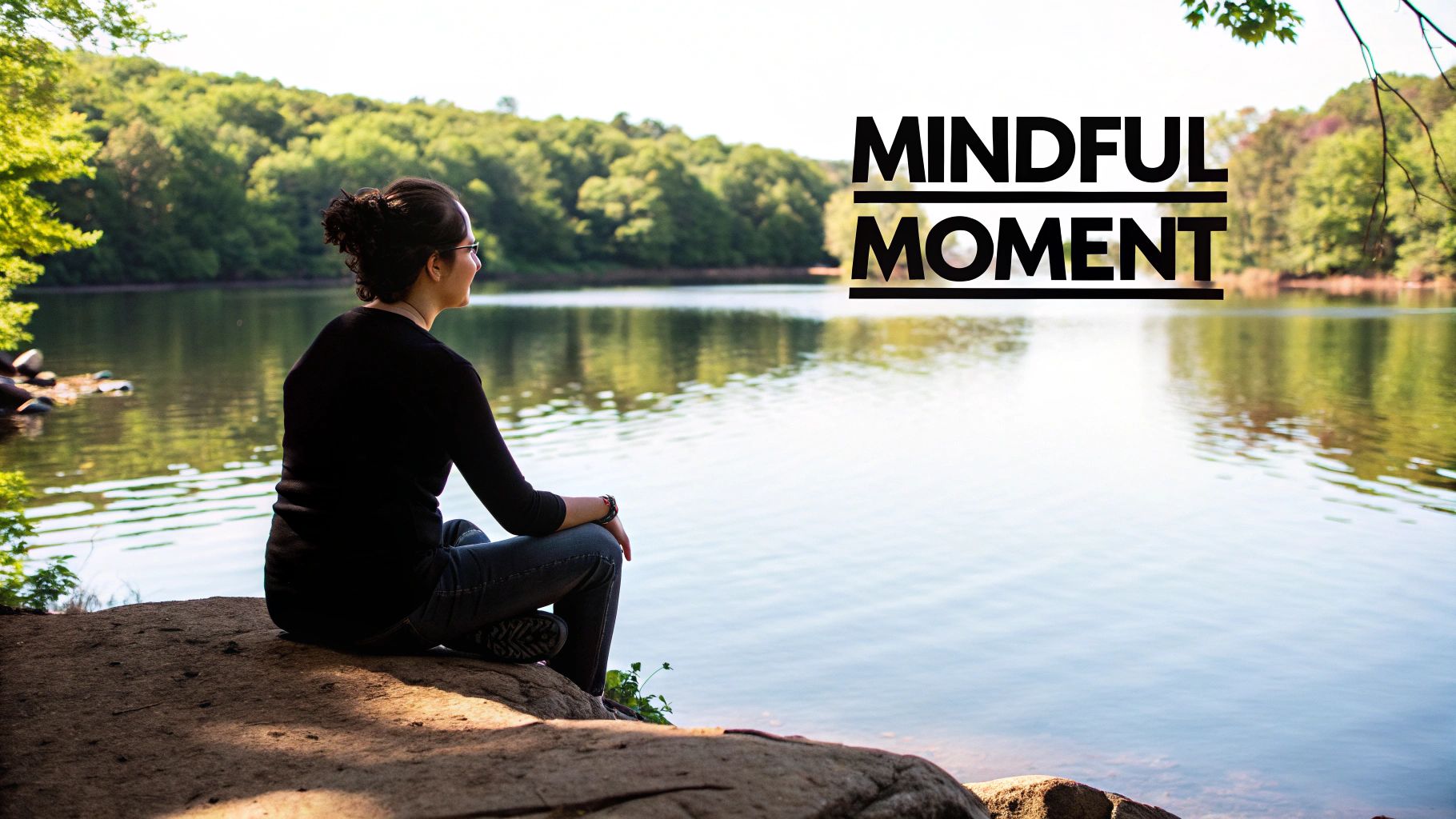
By creating this space between you and your anxious thoughts, you begin to realise they don’t define you. This practice doesn’t aim to stop the thoughts, but rather to change your relationship with them. This shift helps to calm your nervous system, reduce the intensity of anxious feelings, and cultivate a sense of inner peace that stays with you long after your practice ends.
Putting it into Practice
You can practise mindfulness anywhere, without any special tools. It’s about finding a moment to pause and connect. Here’s a simple way to begin your journey:
- Start small: Find a comfortable seat and set a timer for just five minutes. Use a guided meditation from an app like Headspace or Calm to help you start.
- Focus on an anchor: Gently bring your attention to the sensation of your breath. Notice the air entering and leaving your body without trying to change it.
- Acknowledge wandering thoughts: Your mind will naturally wander. When it does, kindly acknowledge the thought and gently guide your focus back to your breath.
- Build a routine: Try to practise at the same time each day to create a consistent habit of self-care.
This gentle, non-judgmental awareness allows you to respond to stress with clarity rather than react from a place of fear. It’s a way of training your mind for calm.
Practices like mindfulness are at the heart of what we do, creating a foundation for deeper healing. They harmonise beautifully with energy work, helping to prepare the mind and spirit for therapies like Reiki. You can learn more about unlocking your inner peace on our website.
4. Guided Imagery
When anxiety traps you in a cycle of worry, it can feel impossible to escape your own thoughts. Guided imagery is a gentle yet powerful relaxation technique for anxiety that uses your imagination as a sanctuary. It’s like taking a mini-holiday in your mind, travelling to a place where you feel completely safe, calm, and at peace, without ever leaving your chair.
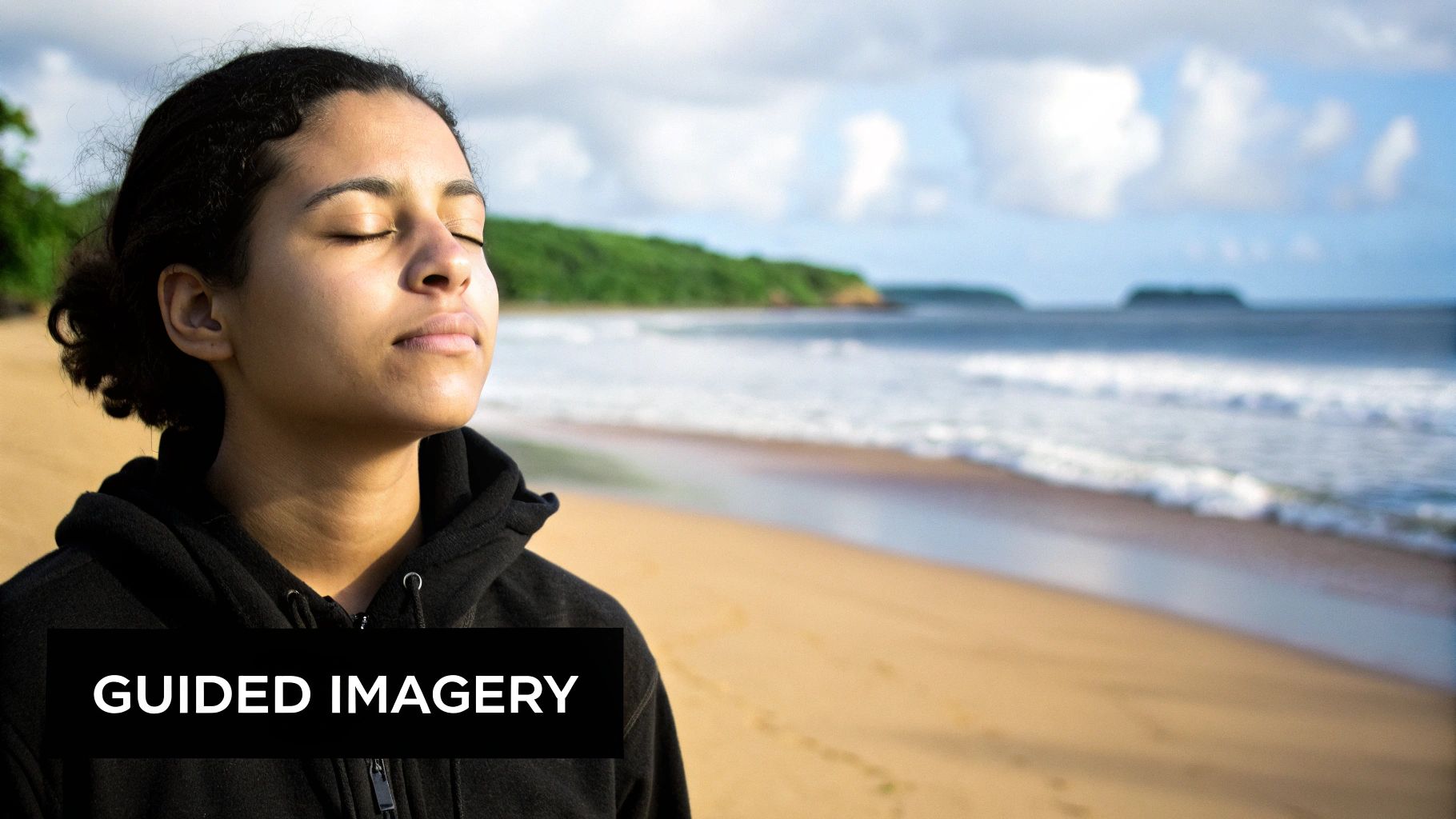
This practice works by focusing your mind on positive, sensory-rich scenes, which helps to shift your attention away from stressors. By vividly imagining sights, sounds, smells, and textures, you can evoke a physical and emotional relaxation response, calming your nervous system just as effectively as if you were truly there. It’s a technique often used by athletes to visualise success and by patients to manage pain.
Putting it into Practice
You can embark on a mental escape anytime you need a moment of peace. Here’s how you can begin your journey with guided imagery:
- Choose your sanctuary: Think of a place, real or imagined, that feels deeply calming to you. It could be a quiet beach, a sun-dappled forest, or a cosy room with a crackling fire.
- Engage your senses: Close your eyes and start to build the scene. What do you see? Notice the colours and the light. What can you hear? Perhaps it’s the gentle lapping of waves or birdsong. What do you smell, taste, or feel on your skin?
- Settle in: Allow yourself to fully immerse in this peaceful environment for 5-10 minutes, letting the feeling of tranquillity wash over you.
This creative practice helps to disconnect from anxious thought patterns and empowers you to create your own inner calm, proving that your mind can be your greatest ally in finding peace.
Guided imagery is a wonderful part of many meditative practices. To explore this further, you can discover more in our guide to meditation techniques for beginners. It’s a skill you can cultivate with practice, creating a reliable inner retreat whenever you need it.
5. Yoga
When anxiety makes your mind feel disconnected from your body, yoga offers a gentle path back to yourself. More than just a form of exercise, yoga is an ancient practice that unites physical postures, conscious breathing, and meditation. It’s a powerful relaxation technique for anxiety because it works on both a physical and mental level, helping you find stability from the inside out.
This mind-body integration helps regulate your nervous system by reducing cortisol, the body’s stress hormone, and increasing calming neurotransmitters. As you move through poses and focus on your breath, you create a meditative state that quiets anxious thoughts and releases physical tension stored in the body, fostering a profound sense of peace. For a deeper dive into how yoga specifically targets mental well-being, explore the benefits of Yoga for stress relief.
Putting it into Practice
You don’t need to be flexible to start; you just need a willingness to connect with your body. Here are a few tips to begin:
- Start gently: Choose a beginner or restorative yoga class. These styles focus on slow movements and deep relaxation.
- Focus on grounding poses: Poses like Child’s Pose, Legs-Up-the-Wall, and gentle forward folds are excellent for calming the nervous system.
- Prioritise breath: Pay more attention to the rhythm of your breath than to achieving a perfect posture. The breath is your anchor.
- Use props for support: Don’t hesitate to use cushions, blocks, or blankets to make poses more comfortable and accessible.
Yoga teaches you to find comfort in stillness and to listen to your body’s needs, creating a safe space within yourself that you can return to whenever you feel overwhelmed.
Here at Natural Light Wellness Spa, we believe in the holistic power of practices like yoga. It’s a journey of self-compassion, helping you build resilience and find your centre, one gentle breath at a time.
6. Grounding Techniques (5-4-3-2-1)
When anxiety pulls you into a vortex of what-ifs and worst-case scenarios, it can feel like you’re drifting away from the present moment. Grounding techniques are like an anchor, firmly pulling your awareness back to the here and now. They are powerful relaxation techniques for anxiety because they use your senses to interrupt overwhelming thoughts and re-establish a feeling of safety in your body.
This method works by shifting your focus from internal distress to the external world. By consciously noticing the physical environment around you, you send a signal to your nervous system that you are not in immediate danger. This simple act of reorientation can stop a panic attack in its tracks and bring a profound sense of calm, making it an invaluable tool for managing acute moments of anxiety.
Putting it into Practice
The 5-4-3-2-1 method is easy to remember and can be done anywhere, whether you’re at your desk or in a busy shop. It requires no equipment, just your focused attention. Here’s how to do it:
- Acknowledge 5 things you can see: Look around and name five objects in your sight, like your teacup, a plant, or the colour of the wall.
- Acknowledge 4 things you can feel: Notice four physical sensations, such as the texture of your chair, the feeling of your feet on the floor, or the softness of your jumper.
- Acknowledge 3 things you can hear: Listen for three distinct sounds. It could be the hum of a computer, birds singing outside, or the sound of your own breathing.
- Acknowledge 2 things you can smell: Identify two scents in your environment, like the aroma of coffee or the faint smell of a scented candle.
- Acknowledge 1 thing you can taste: Focus on one thing you can taste. This could be the lingering flavour of your last drink, or simply the neutral taste of your own mouth.
This sensory checklist methodically reconnects you with your body and your surroundings, creating a safe distance from the anxious thoughts that were consuming you.
It’s a practice we often share in our wellness workshops at Natural Light Wellness Spa. Think of it as your emergency stop button for anxiety, a compassionate way to guide yourself back to solid ground whenever you feel lost in the storm.
7. Tai Chi
When anxiety makes your world feel chaotic and your thoughts race uncontrollably, finding a gentle way to anchor yourself can feel like a godsend. Tai Chi, often described as ‘meditation in motion,’ is one of the most graceful relaxation techniques for anxiety. It guides you to a state of calm not through stillness, but through slow, flowing movements that synchronise the mind and body.
This ancient Chinese martial art combines deep, diaphragmatic breathing with a series of deliberate, fluid postures. This mindful movement activates your body’s relaxation response, reducing stress hormones like cortisol while improving balance and focus. It’s a beautiful practice that nurtures a profound sense of inner peace and stability, helping you navigate life’s pressures with more poise.
Putting it into Practice
Embracing Tai Chi is about progress, not perfection. The focus is on the feeling of the movement and the rhythm of your breath. Here’s how you can begin your journey:
- Start simple: Begin with a short, foundational form, such as the 8 or 12-movement sequence. These are designed for beginners and are easy to learn.
- Find your flow: Join a beginner’s class at a local community centre to learn the correct form and benefit from the gentle energy of a group setting.
- Breathe with movement: Focus on coordinating your deep breathing with each slow movement. Let the breath guide your body, not the other way around.
- Practice outdoors: When possible, practise in a peaceful park or garden to deepen your connection with nature and enhance the calming effects.
The goal isn’t to master every posture perfectly overnight, but to feel the connection between your breath, body, and mind. This mindful focus gently quiets anxious thoughts.
Here at Natural Light Wellness Spa, we believe in the power of mindful movement to heal and restore. Tai Chi offers a unique way to cultivate inner stillness and resilience, a skill that supports you long after you’ve finished your practice.
8. Aromatherapy
Sometimes, a single scent can transport you back in time or instantly change your mood. This powerful connection between smell and emotion is the heart of aromatherapy, a wonderful relaxation technique for anxiety that uses nature’s own essences to soothe the mind. It’s like opening a window on a spring morning and letting a gentle, calming breeze wash over you.
Aromatherapy uses essential oils from plants to tap into the brain’s emotional centre. When you inhale scents like lavender or bergamot, the aroma molecules travel directly to the limbic system, which influences mood and stress. This process can help reduce cortisol (the stress hormone) and encourage your body to release calming neurotransmitters, offering a gentle and natural path to tranquility.
Putting it into Practice
Integrating aromatherapy into your day is simple and brings a touch of spa-like serenity to your own space. Here’s how you can begin enjoying its benefits:
- Choose your scent: Start with well-researched oils known for their calming properties, such as lavender, chamomile, or bergamot.
- Use a diffuser: Add a few drops of your chosen oil to an ultrasonic diffuser to fill your room with a gentle, therapeutic mist.
- Apply topically: Dilute a drop or two with a carrier oil (like coconut or almond oil) and apply it to your wrists or temples. Always do a patch test first.
- Enhance another practice: Add a few drops to a warm bath or place a drop on your yoga mat before you begin, combining its effects with another relaxation method.
The simple act of inhaling a calming scent can create an immediate pause, disrupting anxious thoughts and grounding you in a moment of sensory peace.
Here at Natural Light Wellness Spa, we often weave aromatherapy into our treatments to deepen relaxation. It’s a beautiful way to enhance wellbeing, and something you can easily bring into your own home. If you’d like to explore this further, you can learn more about our aromatherapy massage.
9. Journaling
When worries spiral and repeat themselves in your mind, it can feel like being caught in a dense fog with no clear path forward. Journaling offers a way to clear that fog, acting as a gentle yet powerful relaxation technique for anxiety. It is the simple act of writing down your thoughts and feelings, creating a space to untangle them from the inside and lay them out on paper.
This practice helps to externalise your internal world, which can immediately lessen the emotional weight of your anxieties. By giving your worries a physical form outside of your head, you can gain perspective, identify recurring patterns, and begin to understand your triggers. It’s a quiet conversation with yourself that fosters self-awareness and organises the chaos of anxious thoughts.
Putting it into Practice
All you need is a pen and a notebook, or even a blank document on your computer. The goal is expression, not perfection. Here are a few ways to begin your therapeutic writing journey:
- Set a gentle routine: Dedicate just 10-15 minutes each day to write. Consistency is more important than length.
- Use a simple prompt: If you’re unsure where to start, ask yourself, “What am I feeling anxious about right now and why?”
- Focus on feelings: Don’t just list events. Explore the emotions tied to them. How did that meeting make your body feel? What thoughts did it spark?
- Try gratitude: Balance worry-focused entries by also noting three things you are grateful for. This helps to shift your perspective towards positivity.
Writing things down stops them from endlessly circling in your mind. It transforms abstract fears into manageable thoughts you can observe and address.
Journaling is a deeply personal and restorative practice. It’s a tool for self-compassion that aligns perfectly with our ethos here at Natural Light Wellness Spa, empowering you to find your own centre amidst life’s challenges.
10. Music Therapy
Sometimes words aren’t enough to soothe a busy mind, and that’s where the universal language of music can offer a powerful embrace. When anxiety feels like a constant, disruptive hum in the background, music therapy acts as a gentle counter-frequency, guiding your mind and body back to a state of harmony. It’s more than just putting on your favourite tunes; it’s the intentional use of sound to calm your nervous system.
This incredible technique works by tapping into our brain’s primal response to rhythm and melody. Specific frequencies and tempos, particularly those around 60-80 beats per minute, can slow your heart rate, lower cortisol levels, and activate your body’s natural relaxation response. This makes it one of the most accessible relaxation techniques for anxiety, offering a passive yet profound path to peace.
Putting it into Practice
You can easily integrate music therapy into your daily routine to manage stress and find moments of calm. Here are a few simple ways to begin:
- Create purposeful playlists: Curate different playlists for different needs. One might feature slow, instrumental pieces for winding down before sleep, while another could have uplifting ambient music for a stressful workday.
- Choose the right tempo: For optimal relaxation, select music with a rhythm of around 60-80 beats per minute. This tempo often mirrors a calm resting heart rate.
- Use headphones: For a truly immersive experience, use noise-cancelling headphones to block out external distractions and let the music fully envelop you.
- Combine with other techniques: Enhance the effect by pairing your listening session with deep breathing exercises or a gentle meditation practice.
Music has a unique ability to bypass the conscious, overthinking mind and speak directly to our emotional core, providing comfort when we need it most.
At Natural Light Wellness Spa, we understand the deep connection between sound and serenity. Incorporating music into your wellness toolkit is a simple, beautiful way to support your mental wellbeing, transforming any space into a sanctuary of calm.
Relaxation Techniques for Anxiety: Comparison of 10 Methods
| Technique | Implementation Complexity | Resource Requirements | Expected Outcomes | Ideal Use Cases | Key Advantages |
|---|---|---|---|---|---|
| Deep Breathing Exercises | Low (Beginner-friendly) | None, can be done anywhere | Immediate anxiety relief (1-3 minutes) | Quick relief, anywhere, mild anxiety | Immediate effect, no cost, discreet |
| Progressive Muscle Relaxation | Moderate (Beginner to Intermediate) | Quiet space, 15-20 mins | Physical relaxation, reduces muscle tension | Anxiety with physical tension, sleep | Improves body awareness, effective for tension |
| Mindfulness Meditation | Moderate to High (Beginner to Advanced) | Quiet space, consistent practice | Calming, long-term resilience (8+ weeks) | Long-term stress reduction, emotional regulation | Builds resilience, reduces rumination |
| Guided Imagery | Moderate (Beginner to Intermediate) | Quiet space, optional audio | Relaxation and positive mental rehearsal | Visualization-friendly, creative individuals | Customizable, multi-sensory engagement |
| Yoga | Moderate to High (Beginner to Advanced) | Space, possible classes | Physical & mental relaxation, flexibility | Mind-body integration, physical health | Combines movement & mindfulness, community aspect |
| Grounding Techniques (5-4-3-2-1) | Low (Beginner-friendly) | None, portable | Immediate anxiety interruption (1-3 minutes) | Panic attacks, acute anxiety episodes | Portable, no training needed, effective for dissociation |
| Tai Chi | Moderate (Beginner-friendly) | Space, initial instruction | Relaxation, balance, long-term benefits | Gentle exercise, mind-body connection | Low-impact, social aspects, gradual improvement |
| Aromatherapy | Low (Beginner-friendly) | Essential oils, diffuser or inhalers | Immediate calming (minutes) | Passive anxiety relief, complementary | Pleasant, non-invasive, portable |
| Journaling | Low (Beginner-friendly) | Pen/paper or digital device | Emotional processing, anxiety pattern recognition | Self-reflection, emotional insight | Increases self-awareness, tracks progress |
| Music Therapy | Low (Beginner-friendly) | Audio device, headphones | Immediate mood improvement, relaxation (10-15 mins) | Passive or active anxiety relief | Enjoyable, accessible, customizable |
Your Next Gentle Step Towards Wellbeing
As we come to the end of our journey through these gentle practices, I invite you to just pause for a moment. Take one soft, slow breath in, and let it go just as slowly. Notice how you feel right now, in this very moment. Remember, your path to inner peace is entirely your own, and every small step you take is a beautiful and courageous act of self-care.
We’ve explored a whole garden of possibilities today, from the grounding rhythm of Deep Breathing and the mindful release of Progressive Muscle Relaxation to the creative flow of Journaling and the sensory calm of Aromatherapy. Each of these is more than just a technique; it’s a seed of self-compassion you can plant in the soil of your daily life. Think of them not as tasks to master, but as invitations to return to yourself.
Finding Your Anchor
The most powerful discovery is realising you don’t need to master all ten of these methods. The goal is to find what feels like coming home for you.
- Perhaps the structured 5-4-3-2-1 Grounding Technique will become your anchor during a whirlwind of anxious thoughts.
- Maybe the graceful movements of Yoga or Tai Chi will help you reconnect your mind and body, reminding you that they can work together in harmony.
- Or maybe the simple act of putting on a curated playlist for Music Therapy will be the key that unlocks a sense of calm after a long day.
The true value in exploring these relaxation techniques for anxiety isn’t about perfectly executing every step. It’s about building a personal toolkit, a collection of trusted friends you can call upon when the world feels too loud. It’s about empowering yourself with the knowledge that you hold the capacity for calm within you. This is an incredible strength.
A Gentle Invitation
Remember that managing anxiety is not about eliminating it entirely, but about learning to dance with it, to soften its edges, and to create more space for peace. You are learning to become your own sanctuary. Be gentle with yourself through this process. Some days, a single deep breath will be a huge victory, and that is more than enough. You are doing wonderfully.
Exploring these techniques is a loving way to support your nervous system and honour your need for rest. You absolutely deserve that kindness and care.
CONTACT US
Contact Natural Light Wellness Spa to book your holistic treatments today. Our friendly Guildford team is ready to help you find your perfect session. Contact us now to schedule your relaxation and prioritise your wellness.


